



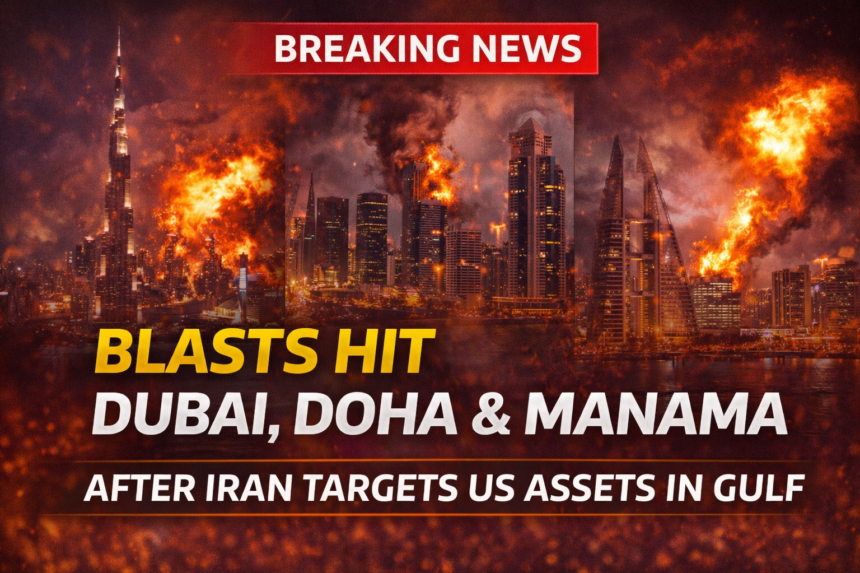
What is More Blasts Hit Dubai, Doha & Manama as Iran Targets US Assets in Gulf?
More Blasts Hit Dubai, Doha & Manama as Iran Targets US Assets in Gulf is a trending topic covered by Sejal News Network with latest updates and insights.
Explosions and missile interceptions were reported across several major cities in the Gulf region on Sunday as Iran continued its retaliatory strikes against United States assets, raising fears of a widening regional conflict.
The reported blasts were heard in Dubai (UAE), Doha (Qatar), and Manama (Bahrain) — cities that have long been seen as stable economic and transport hubs. The incidents, coming on the second consecutive day of attacks, have intensified global concerns about security and civilian safety in the strategically important Gulf region.
Blasts in Multiple Gulf Capitals
Residents and witnesses in Doha described hearing several loud detonations and seeing thick plumes of smoke rising over the city skyline on Sunday morning. Shortly thereafter, another round of explosions echoed through Dubai, with missile interception systems visibly engaging incoming threats over the city’s airspace. Similar explosions were also reported in Manama, where authorities and witnesses confirmed powerful blasts reverberating through the capital.
In Dubai, puffs of white smoke from air defence interceptions were observed alongside dark smoke billowing over key industrial zones. Some explosions took place near major commercial and port areas that are central to the city’s economy, prompting emergency responses from local authorities.
Casualties and Air Defence Response
Officials in the United Arab Emirates confirmed that at least three people were killed during the attacks, including foreign nationals. The defence ministry reported that much of the missile and drone activity was intercepted by air defence systems, but falling debris and blast effects still caused loss of life and property damage in several locations.
In addition to UAE fatalities, other parts of the Gulf also heard sirens and witnessed defensive measures as governments scrambled to respond to the unfolding situation. Air defence systems in neighbouring countries, including Kuwait, were active in intercepting hostile drones on subsequent days as hostilities continued.
Wider Context of the Retaliation
The recent series of explosions across Gulf cities follow a broader wave of Iranian retaliation after strikes by the United States and Israel that resulted in the death of Iran’s Supreme Leader and other senior officials. In response, Iran has launched multiple missile and drone attacks targeting what it considers legitimate military and strategic assets, including U.S. bases and allied facilities throughout the region.
These developments have triggered concerns about potential escalation, as Gulf states navigate a complex security landscape with both regional and global implications.
Regional Impact and International Watch
The repeated blasts in key economic centres have disrupted normal life in the affected cities, with authorities urging residents to remain cautious and follow safety advisories. The incidents have also impacted air travel and port operations in some areas, adding to uncertainty and anxiety among local populations.
Global diplomatic circles are closely monitoring the evolving situation, urging restraint and increased dialogue to prevent further escalation. With multiple nations now drawn into the crisis, the risk of a broader conflict remains a pressing concern for world leaders and regional governments alike
For More News
News: Sejal News Network
Latest Updates के लिए हमारा App डाउनलोड करें
Available on Play Store
Breaking News | Entertainment | Politics | Viral Updates
Fast, Reliable & Trusted News Network