

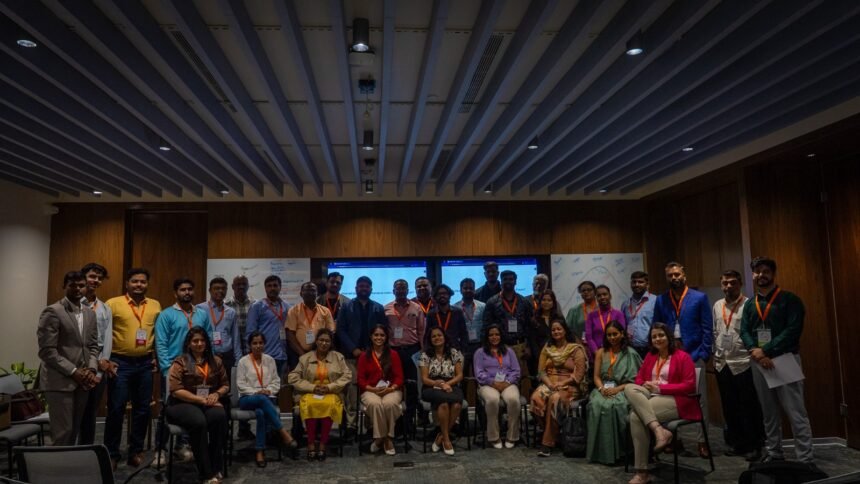
Bengaluru (Bellandur) | December 20
For decades, Human Resources has been viewed primarily as a functional department—responsible for recruitment, compliance, and employee administration. However, as organisations face increasing workforce complexity, shifting employee expectations, and sustained productivity pressures, this traditional view of HR is rapidly becoming outdated. Addressing this changing reality, Ethika Insurance Broking Pvt. Ltd. conducted its “HR to CEO” workshop on December 20 in Bellandur, Bengaluru.
The workshop challenged participants to rethink a fundamental assumption: What if HR is not just a support function, but a business driver? Rather than focusing on leadership theory or motivational concepts, the session examined how HR can operate with a CEO-like mindset—balancing employee experience with organisational outcomes.
The session was led by Susheel Agrawal, Founder and CEO of Ethika Insurance Broking Pvt. Ltd., who positioned HR as a critical force in shaping organisational energy, productivity, and long-term sustainability.
“HR already influences every stage of the employee lifecycle,” Agrawal noted. “When HR begins to see this influence through a business lens, it moves closer to the role of a CEO.”
Moving Beyond the Traditional HR Lens
Participants discussed how HR has historically been confined to transactional responsibilities. While these responsibilities remain important, the workshop highlighted that they represent only a fraction of HR’s potential impact.
Every hiring decision affects productivity. Every engagement initiative influences retention. Every cultural signal impacts performance. The workshop encouraged HR professionals to recognise these connections and take ownership of outcomes rather than processes.
By shifting focus from what HR does to what HR enables, the session reframed HR as a function that directly contributes to organisational success.
HR as the Chief Energy Officer
A defining concept explored during the workshop was the idea of HR as a Chief Energy Officer. Participants examined how employee energy—motivation, engagement, and emotional well-being—plays a critical role in organisational performance.
The workshop highlighted that even well-designed systems fail when employee energy is low. Fatigue, disengagement, and burnout quietly erode productivity and collaboration, often without immediate visibility in financial reports.
HR professionals were encouraged to take responsibility for sustaining positive organisational energy by designing systems, policies, and experiences that support employees rather than exhaust them.
Introducing Return on Happiness (ROH)
One of the most impactful discussions centred on Return on Happiness (ROH). The workshop positioned employee happiness not as a “soft” concept, but as a measurable driver of business outcomes.
Participants explored how disengagement leads to hidden costs—attrition, absenteeism, errors, and reduced output. In contrast, engaged employees contribute more consistently, collaborate better, and stay longer.
The ROH framework helped participants connect employee experience initiatives with tangible results, enabling HR professionals to articulate their value in business terms.
HR’s Role in Organisational Sustainability
The workshop also examined HR’s role in building sustainable organisations. Participants discussed how stability, adaptability, and growth are deeply influenced by workforce engagement and culture.
Organisations with strong HR-business alignment are better positioned to navigate uncertainty. HR professionals who understand business priorities can design people strategies that support both performance and resilience.
The session highlighted that sustainability is not achieved through short-term fixes, but through consistent attention to employee experience and organisational energy.
Redefining HR’s Identity
A recurring theme throughout the workshop was identity. Participants reflected on how HR professionals often underestimate their influence by viewing themselves as executors rather than contributors.
The workshop encouraged HR leaders to redefine their professional identity—from administrators to business partners. This shift, participants noted, does not require authority, but clarity of impact and confidence in decision-making.
By understanding financial, operational, and strategic realities, HR professionals can engage more effectively with leadership teams and influence outcomes.
From Support Function to Business Enabler
The “HR to CEO” workshop reinforced that HR’s evolution is not optional. As organisations become more people-driven, HR’s ability to connect employee experience with business performance will determine its relevance and impact.
Participants agreed that HR’s future lies in its ability to think holistically—balancing care for people with accountability for results.
The workshop concluded with a clear message: when HR adopts a CEO mindset, it becomes a powerful enabler of productivity, stability, and long-term success.
Through the “HR to CEO” initiative, Ethika Insurance Broking Pvt. Ltd. created a platform for HR professionals to step beyond traditional boundaries and reimagine their role as drivers of business value—marking a significant shift in how HR contributes to the modern organisation.
Website = https://www.ethika.co.in/
📰 Latest from Sejal News Network
- Candid Talks with RV May Be Pulled Down Amid Legal Concerns, Sparks Industry-Wide Speculation
- LorryMama Focuses on App-Based Logistics to Simplify Transport Across India
- IndiGo Launches 30+ New Routes from Navi Mumbai Airport — Massive Boost to India’s Air Connectivity
Published by Sejal News Network
