


Thane [India], September 7: The proposed Thane Integral Ring Metro project is facing growing opposition from residents, activists and environmental groups, even as the government and MahaMetro push ahead with plans for the ambitious urban transport corridor.
- Residents Form Human Chain Against Ring Metro
- Residents Want Better Buses and Roads First
- Environmental Impact Becomes a Major Concern
- Rehabilitation of Families Is Another Flashpoint
- Why the Government Wants the Ring Metro
- MahaMetro Says Underground Section Will Be Around 20 Metres Deep
- Government Promises Public Consultation
- Thane Ring Metro: Development vs Environment
The project, estimated at around ₹12,100 crore, is designed to create a 29-km metro ring around Thane and improve connectivity across several important parts of the city. However, protesters argue that the government should first strengthen existing public transport, roads and basic infrastructure before investing such a huge amount in another metro corridor.
Residents Form Human Chain Against Ring Metro
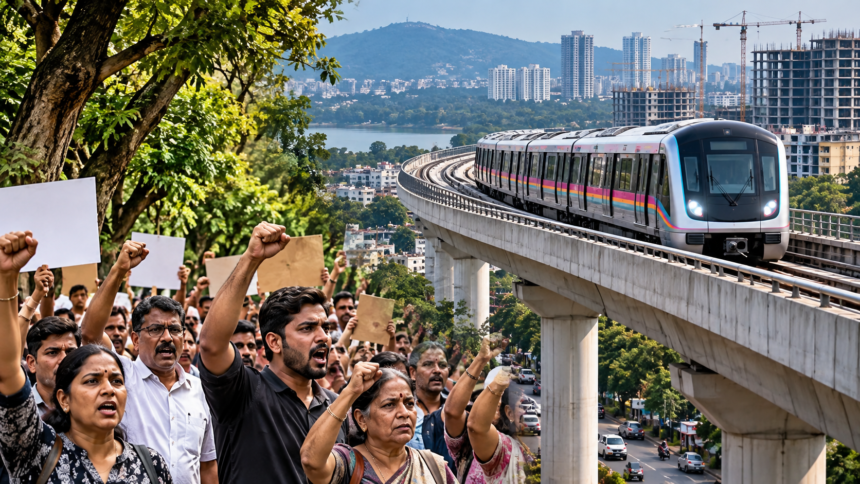
On September 6, several hundred Thane residents participated in a protest organised by the ‘Thane Against Ring Metro’ group.
Despite heavy rain, protesters formed a human chain between Swami Junction and Prashant Corner to voice their opposition to the project. Participants included residents, professionals, environmental activists and members of citizens’ groups.
The latest protest follows an earlier signature campaign, indicating that opposition to the project is becoming more organised.
Residents Want Better Buses and Roads First
One of the primary arguments raised by protesters is that Thane’s existing public transport system needs improvement before another major rail project is taken up.
Activists have demanded an increase in the Thane Municipal Transport (TMT) bus fleet, better service frequency and improved road connectivity to areas that currently have limited public transport options.
Activist Radhika Rane has also called for ridership data from the existing metro lines to be properly assessed before the government commits to another large-scale metro project.
The protesters question whether the proposed Ring Metro will generate sufficient ridership to justify its enormous cost.
Environmental Impact Becomes a Major Concern
Tree cutting has emerged as another major point of opposition.
According to protesters, approximately 3,900 trees could be affected by the project. Environmental activists have raised concerns about the ecological impact of removing mature trees and questioned whether transplantation can adequately compensate for the loss.
Activists have also criticised the absence of a functioning Tree Authority Committee in Thane for several months.
They argue that without the committee, citizens have been unable to properly participate in the statutory process related to proposed tree cutting and raise objections through public hearings.
Rehabilitation of Families Is Another Flashpoint
Residents and elected representatives have also raised concerns about the rehabilitation of families that could be affected by the proposed alignment.
During a recent presentation by MahaMetro, representatives reportedly said that surveys related to displacement were still incomplete.
There are concerns that around 1,400 to 1,500 families in areas including Lokmanya Nagar, Manoramanagar and Sevalal Nagar could be affected, while detailed rehabilitation plans were yet to be presented.
NCP (SP) MLA Jitendra Awhad also claimed that around 30% of slum surveys were still incomplete.
State Transport Minister Pratap Sarnaik has expressed displeasure over being left out of discussions concerning route alignment decisions, adding another political dimension to the controversy.
Why the Government Wants the Ring Metro
The government maintains that the project is important for Thane’s future transportation needs.
The 29-km corridor will include 22 stations, with 26 km planned as elevated track and around 3 km underground. The route is intended to connect areas including Naupada, Wagle Estate, Dongripada, Hiranandani Estate, Kolshet and Saket.
The Union Cabinet had approved the project with an estimated completion cost of ₹12,200.10 crore and a target of making it operational by 2029. The project is being executed by MahaMetro.
Government projections estimate daily ridership could reach around 6.47 lakh passengers by 2029, increasing to 7.61 lakh by 2035 and 8.72 lakh by 2045.
Officials argue that the Ring Metro will provide faster and more sustainable public transport while helping reduce road congestion.
MahaMetro Says Underground Section Will Be Around 20 Metres Deep
MahaMetro has also provided clarification on construction near Thane railway station.
The agency said the underground portion would run at a depth of approximately 20 metres. Buildings located within five metres of the underground alignment would require the necessary safety clearances, according to the project authorities.
However, residents remain concerned about construction-related disruption, traffic changes, safety and the long-term impact of the route on neighbourhoods.
Earlier, residents of areas such as Eden Woods had also raised objections, particularly where the proposed alignment and station locations are close to residential complexes. Their concerns include access to buildings, emergency vehicle movement, construction noise and changes to the surrounding environment.
Government Promises Public Consultation
The administration has indicated that it does not want to ignore residents’ concerns.
Thane Municipal Commissioner Saurabh Rao said around 70% of the proposed route alignment is already available and that land acquisition would be expedited.
He also said the civic administration and MahaMetro would prioritise rehabilitation of affected residents. Written suggestions from elected representatives and other stakeholders will be collected and considered while preparing the Detailed Project Report (DPR), which is expected to be prepared by January 2027.
MahaMetro has also been directed to conduct public interaction programmes to explain the project’s route, objectives and expected benefits.
Thane Ring Metro: Development vs Environment
The opposition to the Ring Metro highlights a larger debate facing rapidly developing cities like Thane: how to expand public transport without causing excessive environmental damage or displacement.
Supporters see the project as essential for tackling Thane’s growing traffic and providing a modern mass-transit network.
Opponents, meanwhile, want the government to first demonstrate the need through existing metro ridership figures and improve buses and roads. They are also demanding greater transparency on tree cutting, route alignment and rehabilitation.
For now, the ₹12,100-crore project remains on track, but the growing protests suggest that public consultation and environmental concerns could become crucial issues before construction moves into its next major phase.