


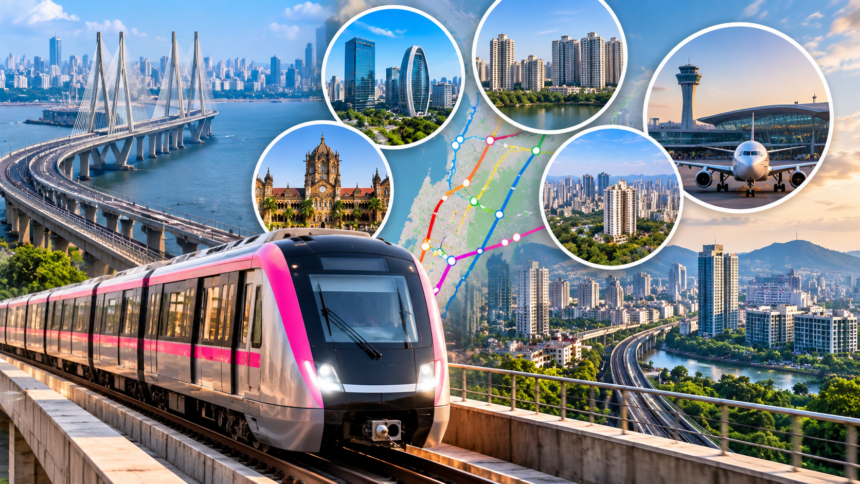
Mumbai [India], September 17: Mumbai and the wider Mumbai Metropolitan Region are set for a major expansion of their Metro network, with multiple new corridors planned to connect western and eastern suburbs with Thane, Bhiwandi, Kalyan, Taloja and Navi Mumbai. According to a recent NDTV report, the expanded network is expected to reach around 374 km by 2030, bringing Metro connectivity closer to major railway stations, commercial centres and both Mumbai and Navi Mumbai international airports.
The expansion covers several important corridors that are expected to change how people travel across the Mumbai Metropolitan Region. The planned network includes connections from Lokhandwala and Andheri to Kanjurmarg, Wadala to Thane and Gaimukh, Thane to Bhiwandi and Kalyan, and Kalyan to Taloja. The wider plan also includes links towards Mira-Bhayandar, Badlapur, Ambernath and Navi Mumbai.
One of the important corridors is Metro Line 2B, which will extend the Yellow Line between D.N. Nagar and Mandale. The 23.6-km corridor is planned with 22 stations and will pass through areas including Andheri West, Bandra, Kurla and BKC before reaching Mandale. The corridor is expected to strengthen east-west connectivity and provide another Metro option for people travelling through some of Mumbai’s busiest commercial and residential areas.
The Green Line network, meanwhile, will create a major connection between Mumbai and Thane. Metro Line 4 is planned from Wadala through Ghatkopar, Mulund and Thane towards Kasarvadavali, while Line 4A extends further to Gaimukh. The corridor is listed by MMRDA at around 32.3 km for Line 4 and another 2.7 km for Line 4A.
Another significant project is Metro Line 5, connecting Thane, Bhiwandi and Kalyan. The corridor is around 25 km long and is planned with 17 stations. Once the wider network is developed, passengers from Thane and the surrounding areas will have additional rail-based connectivity towards Kalyan and other parts of the MMR without depending entirely on road transport or suburban railway services.
For western Mumbai, Metro Line 6, also known as the Pink Line, will connect Swami Samarth Nagar in Lokhandwala with Kanjurmarg through Jogeshwari and the Jogeshwari-Vikhroli Link Road corridor. MMRDA currently lists the corridor at about 14.5 km. The elevated line is expected to create a direct east-west Metro connection through an important part of the western and eastern suburbs.
Airport connectivity is another major focus of the expansion. Metro Line 7A is planned to connect Andheri East with Chhatrapati Shivaji Maharaj International Airport, while Line 9 will extend the Red Line from Dahisar towards Mira-Bhayandar. This will add another Metro connection to the airport for passengers coming from the western suburbs.
The proposed Metro Line 8, or Airport Metro, could be particularly significant for the Mumbai region. The corridor is planned to connect Chhatrapati Shivaji Maharaj International Airport with Navi Mumbai International Airport over approximately 35 km. MMRDA describes it as an airport connection between the two international airports.
For Navi Mumbai and the Kalyan-Dombivli region, Metro Line 12 is another important part of the future network. The corridor will connect Kalyan with Dombivli, MIDC areas, Taloja and Amandoot. MMRDA currently lists the project at 23.57 km with 19 stations and says it will provide interchange connections with Metro Line 5, Line 14 and Navi Mumbai Metro Line 1.
The project is already progressing on the ground. According to MMRDA’s status updated on August 31, 2026, work on Line 12 included pile works, pile-cap works, pier works, pier-cap erection and U-girder erection at varying stages of completion. The project cost is listed at approximately ₹5,865 crore, with a projected daily ridership of 2.62 lakh by 2031.
The larger expansion is also expected to strengthen connections between Metro and suburban railway interchange points. Locations such as Kanjurmarg, Kurla, D.N. Nagar and Dahisar East are expected to play important roles in the wider network. Better interchange facilities could allow commuters to shift between Metro corridors rather than travelling long distances by road.
The expansion is significant because Mumbai’s transport demand extends well beyond the boundaries of the island city. Large numbers of people travel every day between Mumbai, Thane, Navi Mumbai, Kalyan-Dombivli, Mira-Bhayandar and other parts of the MMR. A more interconnected Metro network could give commuters additional alternatives to cars, buses and suburban trains, particularly on routes where road congestion is heavy.
According to NDTV’s report, the broader Metro expansion could eventually cover about 374 km by 2030, while MMRDA’s current Metro PIU information lists the total length of the corridors in its network overview at around 337.1 km. The difference reflects the way projects and network components are being counted across different planning updates, so individual corridor timelines and final network length may change as projects progress.
The impact is also expected to extend beyond daily commuting. Improved connectivity can make areas around Metro stations more accessible to businesses, offices, residential projects and commercial developments. At the same time, the actual benefits will depend on construction timelines, interchange facilities, frequency of services and how effectively the new corridors integrate with existing Metro and railway networks.
With several projects under construction and others progressing through different stages, Mumbai’s Metro map is gradually moving towards a much larger regional system. The planned connections from BKC and Kurla to the eastern suburbs, Lokhandwala to Kanjurmarg, Mumbai to Thane and Kalyan, and Mumbai’s existing airport to Navi Mumbai International Airport could significantly reshape cross-region travel once the corridors become operational.