



New Delhi, May 1, 2025
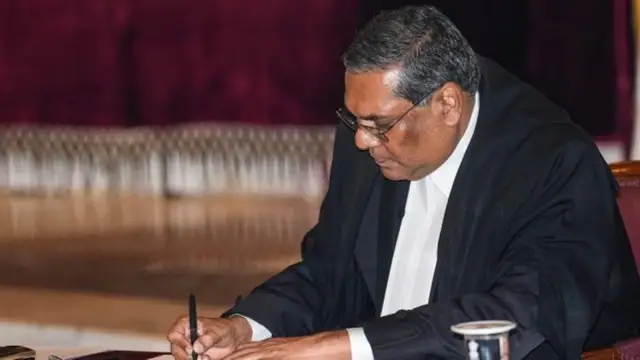
As Chief Justice of India (CJI) Sanjiv Khanna approaches the final weeks of his tenure, a Constitution bench led by him heard heated arguments on the validity of the controversial Waqf Amendment Act, 2025. The two-hour-long hearing saw the CJI striking a delicate balance—pressing the government for clarifications on key provisions while also cautioning the petitioners against overreach in their challenges.
A Middle Path: CJI’s Nuanced Approach
“There are some good aspects too, which neither side is mentioning,” Justice Khanna remarked at the end of the session, signaling his intent to evaluate the law fairly rather than being swayed by political or ideological narratives.
The Waqf Amendment Act, 2025 has been a lightning rod for controversy since its passage, with critics alleging that it undermines Islamic religious endowments while the government defends it as a necessary reform to curb misuse and ensure transparency.
Key Questions to the Government
One of the most pointed exchanges occurred when CJI Khanna asked Solicitor General Tushar Mehta to cite a single instance where Parliament had permitted inter-faith members on boards managing the religious affairs of another community.
When Mehta responded, “Take it from me. I don’t want to name, but take it from me that there are such cases,” the bench—comprising CJI Khanna, Justice Sanjay Kumar, and Justice K.V. Viswanathan—remained unsatisfied and pressed for a concrete example.
The government then cited the Bombay Public Trusts Act, 1950, a secular law governing temples, waqfs, and other religious trusts. However, Justice Viswanathan countered that this might not be an apt comparison, suggesting instead that laws regulating Hindu religious endowments could be more relevant.
Abolishing ‘Waqf by User’: A Contentious Move
Another critical issue raised by the bench was the abolition of the concept of waqf by user, a long-standing legal principle where continuous usage of a property for religious purposes could classify it as waqf land. The government argued that this provision had been widely misused for land grabs, but CJI Khanna pointed out that genuine cases also existed.
“We agree with you that there is misuse, but there are also genuine cases of waqf by use,” he said. “If you are going to denotify waqf by user, it is going to be a problem.”
This observation suggests that the court may seek a middle ground—retaining safeguards against fraud while ensuring legitimate waqf properties are not arbitrarily stripped of their status.
Petitioners’ Arguments Meet Judicial Scrutiny
While the bench questioned the government rigorously, it also set boundaries for the petitioners, led by senior advocate Kapil Sibal.
When Sibal argued that the Limitation Act—which imposes time limits on legal claims—should not apply to waqf properties (as was the case under the 1995 law), CJI Khanna responded that the Limitation Act had both advantages and disadvantages. The removal of the exemption in the 2025 amendment means waqf boards can no longer reclaim encroached properties indefinitely, a change Sibal contended was unfair.
Sibal also raised concerns about the law interfering with Muslim inheritance rights, particularly regarding waqf-alal-aulad (family waqfs). The new Act states that “the creation of a waqf-alal-aulad shall not result in denial of inheritance rights of heirs, including women heirs, of the waqif or any other rights of persons with lawful claims.”
To this, CJI Khanna pointed out: “You cannot say that Parliament cannot make a law on inheritance. We have the Hindu Succession Act.”
Religious Freedom vs. State Regulation
Sibal’s most ambitious argument was that waqf management constitutes an essential religious practice under Islam, protected under Article 26 of the Constitution, which guarantees freedom to manage religious affairs.
Justice Viswanathan, however, cautioned against conflating issues: “Don’t mix the two.” The essential religious practice doctrine—a judicially created test to determine which religious customs are integral to a faith—is itself under challenge before a nine-judge bench. The court’s reluctance to entertain this line of argument suggests it may avoid delving into theological debates in this case.
What Next?
With only 18 working days left before his retirement on May 14, CJI Khanna’s handling of this case will be closely watched. The bench’s questions indicate a possible inclination to uphold parts of the law while striking down or modifying others.
The government’s defense hinges on framing the amendments as secular reforms aimed at preventing misuse, while petitioners argue they disproportionately target Muslim endowments. The court’s eventual ruling could set a significant precedent on how far the state can intervene in religious trust management.
As the hearing adjourned, one thing was clear: the judiciary is treading carefully, aware that its decision will have far-reaching consequences for religious autonomy, property rights, and legislative authority in India.
(Reported by Legal Correspondent, New Delhi)
Waqf Amendment Act, Waqf Amendment Act, Waqf Amendment Act, Waqf Amendment Act, Waqf Amendment Act, Waqf Amendment Act, Waqf Amendment Act
“Exciting News! Sejal News Network is now on WhatsApp Channels
Subscribe today by clicking the link and stay updated with the latest news!” Click Here

