



Navi Mumbai [India], September 8: The Amazon Think Big Space (TBS) Programme is taking another step towards strengthening STEM education in Navi Mumbai by focusing on one of the most important parts of the learning ecosystem — teachers.
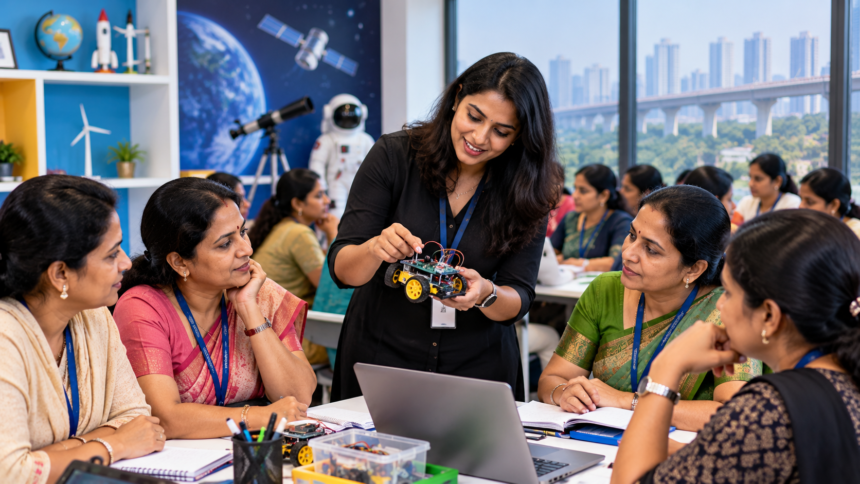
Implemented by the Learning Links Foundation (LLF) in collaboration with the Navi Mumbai Municipal Corporation (NMMC), the programme recently organised a two-day STEM Teacher Capacity Building Workshop for more than 140 teachers from NMMC-run government schools.
The workshop, held on August 20 and 21, 2026, was designed to help educators move beyond conventional classroom teaching and adopt more experiential, technology-enabled and student-focused methods.
Focus on Experiential and Student-Centred Learning
The training programme focused on helping teachers make classroom learning more interactive and practical. Instead of relying only on traditional teaching methods, educators were introduced to approaches that encourage students to explore concepts, ask questions, experiment and develop solutions to real-world problems.
Teachers were trained in experiential STEM pedagogy, process-based learning and Design Thinking, with an emphasis on encouraging creativity, collaboration, critical thinking and problem-solving among students.
The programme also introduced educators to AI and EdTech tools, giving them practical ideas about how emerging technologies can be incorporated into everyday teaching.
This approach is aimed at making students active participants in the learning process rather than simply recipients of information.
Teachers Explore Real-World Problem Solving
As part of the workshop, teachers participated in activities involving reverse engineering and real-world STEM problem-solving.
The objective was to help educators understand how classroom concepts can be connected with situations students encounter in everyday life. Such methods can encourage children to experiment with ideas, understand how things work and develop their own solutions.
The training also included sessions around ASER data analysis, allowing teachers to better understand students’ learning levels and identify areas where additional attention may be required.
At the conclusion of the programme, participating teachers developed STEM Action Plans based on their individual classroom requirements. These plans are intended to help educators apply the learning from the workshop in their schools and create sustained improvements in classroom practices.
NMMC Education Officials Support the Initiative
The workshop was attended by Ashok Kadus, Education Officer, NMMC, and Sulbha Barghare, Extension Officer, Education Department, NMMC.
Kadus highlighted the role of the Amazon Think Big Space initiative in building confidence and STEM capabilities among students while also strengthening teachers’ ability to translate concepts into effective classroom practices.
The collaboration between Amazon, LLF and NMMC is focused not only on providing STEM infrastructure but also on building the capacity of teachers so that the impact of the programme continues inside classrooms.
Seven Years of Collaboration
The teacher training initiative is part of a longer partnership between the organisations.
Over the past seven years, the collaboration has conducted five large-scale teacher training programmes, reaching more than 300 unique teachers. According to programme information, more than 70 per cent of participating teachers return for training each year, indicating continued engagement with professional learning and STEM-focused teaching practices.
The programme’s wider student reach extends to thousands of children studying in NMMC schools. Regular handholding sessions are also conducted to help teachers apply the concepts and methodologies introduced during training.
Teacher Spotlight and Excellence Awards
The programme also includes initiatives designed to recognise educators who are bringing innovative practices into their classrooms.
Through the Teacher Spotlight Series, participating teachers share examples, photographs and videos showing how they have implemented STEM practices in their schools.
Teachers are recognised for innovative classroom initiatives, while the programme’s Teacher Excellence Awards further highlight educators who have made a significant contribution to STEM learning.
According to the programme details, the top 10 teachers are shortlisted through a selection process, with the top three being recognised for their work and contribution.
STEM Labs, STEM Corners and Mobile Learning
The Amazon Think Big Space Programme follows multiple models to make STEM education accessible to students across Navi Mumbai.
These include Think Big STEM Labs, which provide dedicated innovation and learning spaces; STEM Corners, which bring compact STEM learning facilities into classrooms; and the Mobile STEAM Van, which takes hands-on STEM and AI learning directly to schools that may have limited infrastructure.
The mobile learning model builds on Amazon’s earlier Think Big Space initiative in Navi Mumbai, which was designed to give students access to practical learning in areas such as science, mathematics, electronics, robotics, computer science and emerging technologies. Amazon has previously highlighted how its Think Big Spaces enabled students from NMMC schools to work on projects and participate in science and technology competitions.
Preparing Students for a Technology-Driven Future
The programme’s focus is now extending beyond conventional STEM learning to areas including communication skills, holistic development, AI and technology-enabled education.
Students are also being provided opportunities to participate in national and international STEM and robotics competitions, giving them exposure beyond the classroom.
By investing in teacher development alongside infrastructure and student programmes, the Amazon Think Big Space initiative aims to create a longer-term impact across Navi Mumbai’s government schools.
The latest teacher workshop is therefore not just another training programme. It represents an effort to ensure that the technology, innovation spaces and STEM resources available to students are supported by educators equipped to use them effectively.
As STEM and AI continue to become increasingly important to future careers, initiatives that strengthen both teacher capacity and practical learning opportunities could play a significant role in preparing Navi Mumbai’s students for a technology-driven future.