



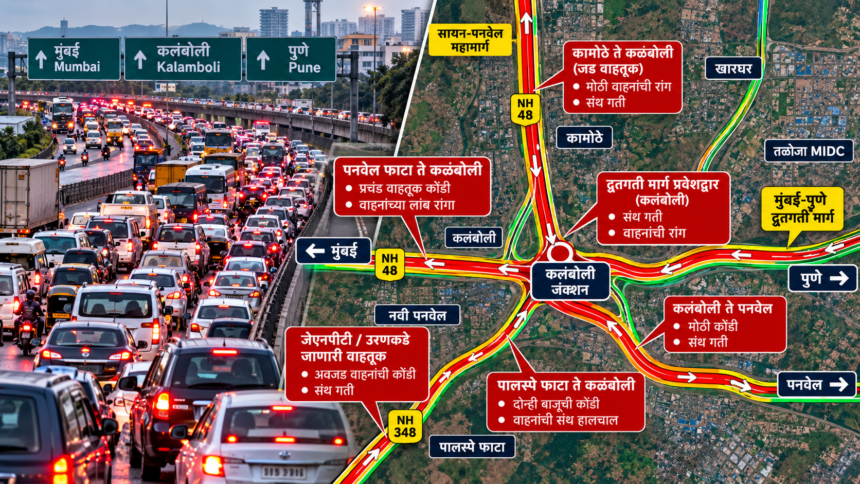
Navi Mumbai [India], September 26: Traffic movement around Kalamboli Junction in Navi Mumbai was severely affected on Saturday as long queues of vehicles formed following delays in reopening the Shilphata route during the ongoing Ganesh Visarjan processions. The congestion affected traffic heading towards Mumbai, Pune, Panvel, Palaspe Phata, Uran and the JNPT area.
The traffic disruption was linked to arrangements made for Anant Chaturdashi, when large Ganesh immersion processions were taking place across the Thane region. The Shilphata road had been closed as part of the traffic arrangements, but the processions continued for longer than expected, preventing authorities from reopening the route at the scheduled time. As a result, vehicles travelling through the corridor began piling up towards Kalamboli Junction.
According to Navi Mumbai Traffic Police Deputy Commissioner Dr Rahul Khade, the closure at one point created a chain reaction, with vehicles getting held up on connecting roads as well. The congestion gradually spread towards Kalamboli, which is an important junction connecting several major routes in the Mumbai Metropolitan Region.
The impact was not limited to Kalamboli. Traffic movement in parts of Thane and Kalwa was also affected by the immersion processions. Long queues were reported around areas including Retibunder, Kalwa and Parsik Nagar, while traffic on certain roads was diverted to alternative routes to allow the processions to pass.
The congestion also had a knock-on effect on the Agra-Mumbai Highway, with traffic approaching Mumbai from the Mankoli Bridge area moving slowly. Vehicles travelling from Kalyan-Dombivli and Nashik towards Mumbai added to the pressure on the road network, contributing to the wider traffic buildup connected to the Shilphata corridor.
Kalamboli Junction is particularly sensitive to traffic disruptions because it serves as a major connecting point between the Mumbai-Pune Expressway, Sion-Panvel Highway, Panvel, Palaspe Phata, Uran and JNPT. When traffic gets blocked on one approach, vehicles can quickly begin accumulating on the other connecting roads. The return of vehicles from Konkan after the Ganesh festival also added to the overall traffic pressure.
Traffic police teams were deployed at multiple locations to manage the situation. Authorities were releasing stranded vehicles in stages and attempting to regulate traffic flow at important junctions. Officials were also working to reopen at least one lane on the Shilphata route so that vehicles could begin moving again and the pressure around Kalamboli could gradually reduce.
Dr Khade said the traffic situation was expected to improve within one to two hours once the Shilphata route was opened and traffic movement returned to normal. However, motorists travelling towards Mumbai, Pune, Panvel, Palaspe Phata, Uran and JNPT were advised to keep additional travel time because of the continuing congestion.
The situation highlights how traffic diversions during major festival processions can quickly affect interconnected highways across Navi Mumbai and the wider Mumbai Metropolitan Region. With Kalamboli functioning as a key junction for traffic travelling between Mumbai, Pune, Panvel, the Mumbai-Pune Expressway and JNPT, even a temporary restriction on a connected route can result in significant delays for motorists.
For commuters travelling through Kalamboli, Panvel, Shilphata and the Mumbai-Pune Expressway corridor, checking the latest traffic updates before starting their journey could help them plan for delays while immersion-related restrictions remain in place.