
What is Mumbai 3.0: Maharashtra’s ₹4,000 Crore Mega City Plan Near Atal Setu and Navi Mumbai Airport?
Mumbai 3.0: Maharashtra’s ₹4,000 Crore Mega City Plan Near Atal Setu and Navi Mumbai Airport is a trending topic covered by Sejal News Network with latest updates and insights.
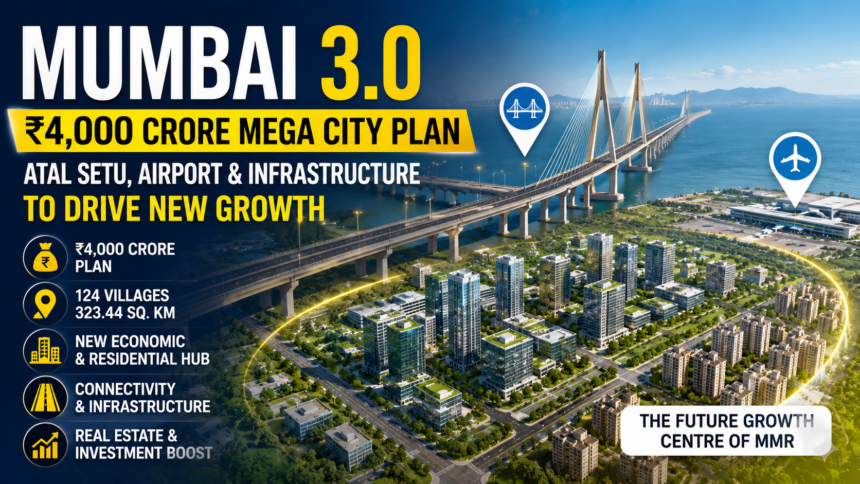
Mumbai: Maharashtra’s ambitious Mumbai 3.0, officially known as the Karnala-Sai-Chirner (KSC) New Town, is emerging as one of the biggest planned urban development projects in the Mumbai Metropolitan Region. The Mumbai Metropolitan Region Development Authority (MMRDA) has earmarked ₹4,000 crore for the project in its 2026–27 budget, giving a major push to the proposed new economic and residential hub.
The proposed city will cover 124 villages across Uran, Panvel and Pen talukas in Raigad district, spread across approximately 323.44 square kilometres. MMRDA has been appointed as the New Town Development Authority for the region.
Why Is Mumbai 3.0 Being Developed?
Mumbai and Navi Mumbai have both witnessed rapid urban expansion over the years. With increasing pressure on land, housing, roads and infrastructure, Mumbai 3.0 is being planned as a new urban and economic centre rather than simply another residential extension.
The proposed development aims to bring together housing, commercial districts, technology hubs, logistics, healthcare, education and other economic activities within a planned ecosystem. The objective is to create employment opportunities closer to residential areas and reduce the need for long-distance daily travel.
Strategic Location Near Atal Setu and Navi Mumbai Airport
One of Mumbai 3.0’s biggest advantages is its location.
The proposed KSC New Town is situated close to the Atal Bihari Vajpayee Sewri-Nhava Sheva Atal Setu and the Navi Mumbai International Airport, placing it within a rapidly developing infrastructure corridor.
The project is also expected to benefit from major connectivity developments, including:
- Atal Setu
- Navi Mumbai International Airport
- Panvel-Karjat railway corridor
- Virar-Alibaug Multimodal Corridor
- Mumbai-Pune Expressway
- Mumbai-Goa highway connectivity
These infrastructure links could significantly improve connectivity between Mumbai, Navi Mumbai, Panvel, Uran and the wider Raigad region.
A New Economic Hub for the MMR
Mumbai 3.0 is envisioned as more than just a residential township. The proposed economic ecosystem could include sectors such as:
- IT and IT-enabled services
- Global Capability Centres (GCCs)
- Data centres
- Financial services
- Logistics and industrial activities
- Healthcare
- Education
- Commercial and mixed-use developments
The plan also includes townships and industrial corridors, while significant areas are expected to retain green zones, forests and existing rural settlements.
₹4,000 Crore Allocated for 2026–27
The major financial push for the project comes through MMRDA’s infrastructure-focused budget for 2026–27, with ₹4,000 crore earmarked for the Karnala-Sai-Chirner New Town.
Land acquisition and development planning are also moving forward. According to the report, landowners in the 124 villages have been offered different compensation mechanisms, including monetary compensation, development rights and land-pooling options.
What Could Mumbai 3.0 Mean for Real Estate?
The development of a large, infrastructure-driven urban centre could create new real estate micro-markets across the wider Panvel, Uran and Raigad belt.
As connectivity, employment centres and social infrastructure develop, the region could see growing demand across:
- Residential projects
- Commercial spaces
- Logistics and warehousing
- Industrial developments
- Retail and hospitality
- Supporting services
However, the project remains a long-term development plan, and its full impact will depend on infrastructure execution, land acquisition and the pace of planned development. The first phase could begin taking shape toward the end of this decade, while the complete urban ecosystem will take considerably longer to develop.
A Major Step Towards Mumbai’s Next Growth Phase
Mumbai 3.0 represents a significant attempt to create a new growth centre beyond Mumbai and Navi Mumbai. With its location near Atal Setu and the Navi Mumbai International Airport, the KSC New Town could become an important part of the Mumbai Metropolitan Region’s future economic and urban expansion.
For now, the ₹4,000 crore allocation for 2026–27 marks a major step forward, but the transformation of the proposed Mumbai 3.0 into a fully developed city will be a long-term process.