



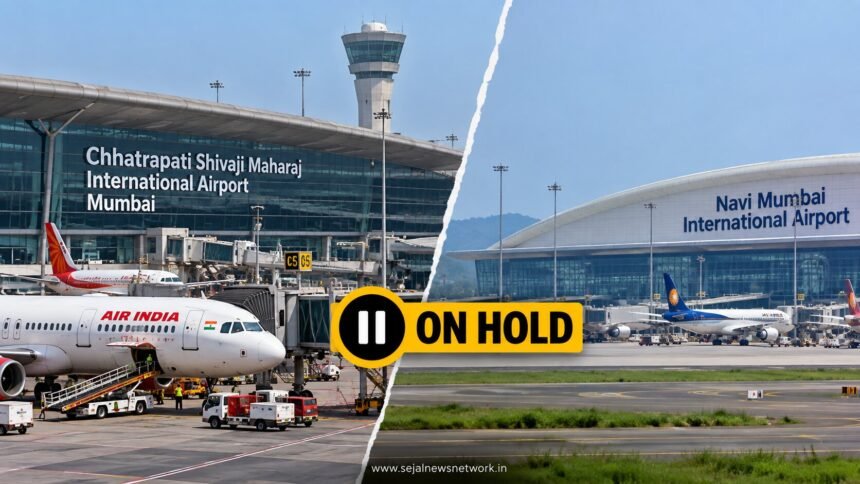
Navi Mumbai [India], October 7: The proposed shift of 265 weekly international flight departures from Mumbai’s Chhatrapati Shivaji Maharaj International Airport to Navi Mumbai International Airport has been put on hold, giving airlines and the airport operator more time to work out a transition plan.
The proposed change was scheduled to begin from October 25, coinciding with the start of the winter flight schedule. Mumbai International Airport Ltd. had planned to temporarily discontinue or shift 265 of the 770 weekly international departures currently operating from Mumbai.
The plan was linked to the redevelopment of Terminal 1 at Mumbai airport. While international operations are largely handled from Terminal 2, the redevelopment of T1 will require around five million domestic passengers a year to be accommodated through T2. This has created the need to free up additional capacity at the international terminal.
Under the original proposal, airlines were asked to either shift selected international services to Navi Mumbai International Airport or temporarily discontinue them. However, several airlines raised concerns over the timing and manner of the proposed transition.
Airlines have pointed out that their winter 2026-27 schedules have already been planned, including aircraft deployment, crew arrangements, international connections and passenger bookings. A sudden change could therefore affect their wider networks and commercial operations.
There are also concerns regarding the readiness of supporting infrastructure at Navi Mumbai International Airport for the affected international services. These include ground handling, aircraft maintenance, catering, cargo operations, crew transportation, regulatory requirements and passenger connectivity.
The proposed shift would have affected several major airlines. IndiGo was expected to see 74 weekly international departures affected, while Air India faced an impact of 33 departures. Akasa Air was expected to have 11 services affected, while Air India Express faced seven. Emirates and Etihad were each expected to have 10 weekly departures affected.
The transition has also raised concerns about passenger convenience. Navi Mumbai International Airport is significantly farther from central Mumbai than the existing airport, meaning passengers travelling to or from the city could face longer road journeys and additional transportation costs.
The Union government’s intervention has now put the October 25 transition plan on hold. Further discussions between the airport operator, airlines and other stakeholders are expected to determine a workable arrangement for shifting operations.
The redevelopment of Mumbai airport’s Terminal 1, however, remains on the agenda. The redevelopment is expected to begin in January 2027, with the new terminal targeted for commissioning in 2029-30.
For passengers, the immediate uncertainty is which international flights, if any, will eventually move to Navi Mumbai. The next phase of discussions is expected to focus on a gradual and coordinated transition that minimises disruption to airline schedules and travellers.
The development also highlights the challenges of operating Mumbai and Navi Mumbai as a dual-airport system. While the new Navi Mumbai airport is expected to play an increasingly important role in the region’s aviation network, airlines are seeking greater clarity and adequate time to adjust their operations.