

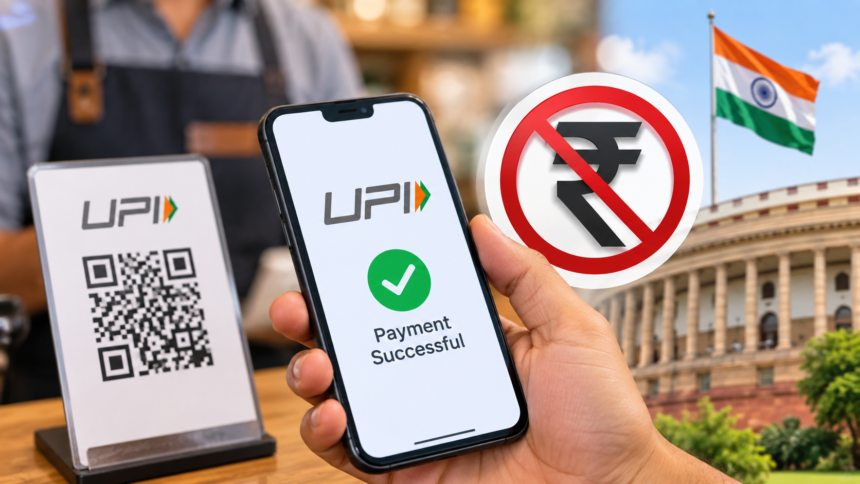
New Delhi [India], September 16: The government has formally clarified the rules governing charges on digital payments, ensuring that UPI transactions of up to ₹2,000 remain free of bank or system-provider charges. Person-to-person UPI transfers will also continue to remain completely free, irrespective of the amount transferred. The clarification comes amid recent concerns that changes to the payment framework could lead to charges being imposed on ordinary UPI users.
The Finance Ministry’s notification states that banks and system providers cannot impose direct or indirect charges on UPI payments up to ₹2,000, as well as payments made through RuPay debit cards under the specified framework. The move is aimed particularly at protecting everyday, low-value digital payments and preventing additional costs from being passed on to users.
For people using UPI to send money to friends, relatives or other individuals, there is no change. The government has specifically clarified that all person-to-person (P2P) UPI transactions will remain free, regardless of the amount. So, sending ₹500, ₹5,000 or ₹50,000 to another individual through UPI will not attract an MDR charge under the new framework.
The important change concerns person-to-merchant (P2M) transactions. Under the new framework, merchant payments above ₹2,000 can attract a Merchant Discount Rate (MDR). The government has clarified that MDR is not a fee charged by the government to customers; it is a charge within the payment ecosystem involving merchants, banks and payment service providers. Banks have also been advised to ensure that merchants do not pass the MDR on to customers as a separate UPI fee.
The government says the new framework will leave the overwhelming majority of merchant transactions unaffected. According to official data, around 96 per cent of P2M UPI transactions will remain free, either because they are below ₹2,000 or because they fall under the zero-MDR framework applicable to qualifying small merchants. MDR is expected to apply to only about 4 per cent of merchant transactions.
The distinction between the number of transactions and their total value is significant. Data cited by The Indian Express shows that only around 4 per cent of P2M UPI transactions in 2025-26 were above ₹2,000, but these transactions represented roughly two-thirds of the total value of merchant UPI payments. India recorded more than 24,000 crore UPI transactions worth approximately ₹314 lakh crore during that financial year.
Under the latest framework, the standard MDR for specified merchant transactions above ₹2,000 is 0.4 per cent, while transactions of ₹75,000 or more are subject to a maximum MDR of ₹300 per transaction. Certain essential sectors, including railways, telecommunications, insurance, fuel and agricultural inputs, have a separate flat MDR of ₹5 for qualifying transactions above ₹2,000. Capital-market-related payments will attract a lower MDR of 0.02 per cent, subject to a ₹300 cap.
Small businesses and street vendors have also been given protection under the framework. Merchants receiving up to ₹1 lakh per month through UPI QR codes under the specified small-merchant category will continue to benefit from zero MDR. This is intended to ensure that neighbourhood shops, small vendors and other low-volume businesses do not face additional payment costs.
The development follows an amendment to the Payment and Settlement Systems Act, 2007, through the Taxation and Other Laws (Amendment) Bill, 2026. The amendment removed an earlier exemption that had effectively prevented charges on certain electronic payment modes, including BHIM-UPI, UPI QR codes and RuPay debit cards. The latest notification establishes which categories remain protected from charges while creating the framework for MDR on specified higher-value merchant payments.
The issue had generated considerable discussion after the legal amendment because of concerns that UPI users could eventually be charged for everyday payments. The Finance Ministry had already clarified in August that consumers would not face transaction charges and that any future MDR would apply only to a limited category of merchant transactions above a specified threshold.
The government has argued that the framework is also intended to address the long-term financial sustainability of the UPI ecosystem. Payment companies and banks have pointed to the rising cost of maintaining digital-payment infrastructure, while a parliamentary finance committee had noted that the absence of MDR creates financial pressure on the system. The government has therefore sought to balance continued free access for individuals and small merchants with a mechanism for supporting payment infrastructure.
For ordinary UPI users, the immediate takeaway is straightforward: there is no blanket charge on UPI payments. Person-to-person transfers remain free regardless of value, and merchant payments up to ₹2,000 remain free. The new MDR framework primarily affects specified higher-value merchant transactions, while the government has said customers should not be charged the MDR separately.
The changes are expected to become an important part of the next phase of India’s digital-payment ecosystem as UPI continues to handle an enormous volume of transactions every month. The government’s latest clarification attempts to preserve free everyday payments while introducing a mechanism to support the infrastructure behind larger merchant transactions.
Google Pay Store : App