



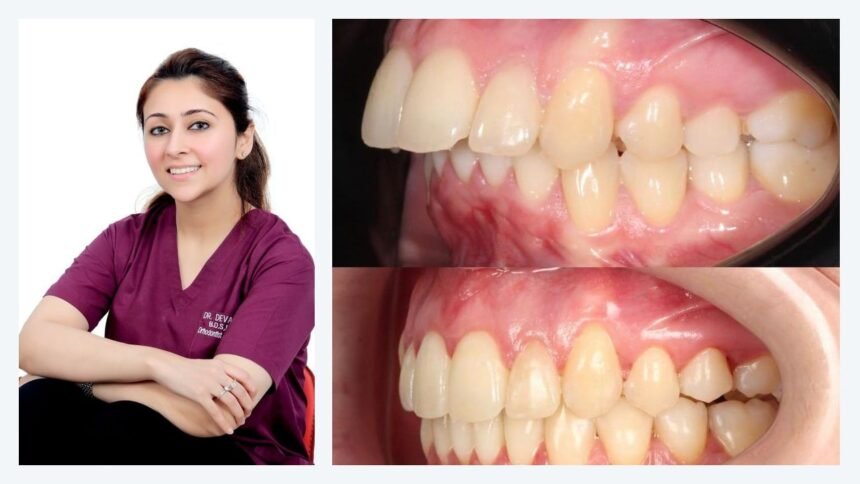
Dr. Devanjali Soin, orthodontist, with before-and-after photographs of an Invisalign case treated at White Dental Healthcare, Indirapuram
Every week, a patient sits in my chair holding a phone with two quotes on it. One is for Invisalign clear aligners. The other, often less than half the price, is from a direct-to-consumer aligner brand promising the same straight smile with fewer visits. The question is always the same: is the difference really worth it?
After sixteen years as an orthodontist, and after seeing the results of both, my answer for most cases is yes. But I want to explain why rather than ask you to take it on trust, because the differences are not visible when you hold two trays side by side.
The material is not the same plastic
Invisalign clear aligners are made from SmartTrack, a patented multilayer thermoplastic developed by Align Technology. It is engineered to deliver a gentle, continuous force and to hold its shape through the one to two weeks each tray is worn. Most lower-cost aligners are thermoformed from generic single-layer plastic. They look identical on day one. By day ten, the difference shows up as a looser fit, less predictable movement, and trays that need to be replaced or “refined” more often. Material science is the part of the price you cannot see.
Treatment is planned before it starts
Every Invisalign case begins with a digital 3D scan and a ClinCheck plan: a tooth-by-tooth simulation of the entire treatment, from the first tray to the last. I can show a patient exactly where each tooth will move and in what order, and adjust the plan before a single aligner is made. That level of planning is what allows Invisalign clear aligners to handle cases that cheaper systems cannot: rotations, bite correction and extraction cases, often with small tooth-coloured attachments bonded to the teeth to give the trays better grip.
Someone qualified is watching
This is the point I care about most. Invisalign is available only through trained and certified dental professionals, and every case is supervised in person from the first scan to the final retainer. Some direct-to-consumer brands have offered at-home impression kits and remote check-ins with minimal clinical oversight. Moving teeth is a medical procedure. Done without supervision, it can worsen undetected gum disease, create new bite problems and jaw pain, damage tooth roots, or simply relapse once treatment stops. Many brands have since added clinical touchpoints, but the level of oversight still varies widely, and the patient usually cannot tell the difference until something goes wrong.
Twenty-five years of evidence
Align Technology launched Invisalign in 1997 and has treated more than fifteen million patients since. They got their FDA approval in 1998 . That history matters in two practical ways. First, there is a large body of published clinical research on what Invisalign clear aligners can and cannot do. Second, the planning software has learned from millions of completed cases, which makes the predicted movements in a ClinCheck plan more reliable. Newer aligner brands may be perfectly adequate for mild crowding, but they are working from a much smaller evidence base.
What the price gap actually buys
Invisalign clear aligners cost more upfront than most Indian alternatives, sometimes considerably more. What you are paying for is the material, the planning software, a specialist’s time at every visit, and the predictability that comes from a system with a long track record. The most expensive aligner treatment is the cheap one that has to be redone. I see those patients too, and the second course of treatment is rarely quick or inexpensive. At our practise in Indirapuram – We guide our patients to choose what’s right, not what’s expensive. We keep our Invisalign Fees reasonable, so you get a better result at a cost-eefective price- which is why we do more Invisalign cases than its cheaper alternatives.
Questions to ask any aligner provider
Whichever system you choose, ask these before you pay. Who is clinically responsible for my case, and what is their qualification? Will I see a full digital plan before treatment starts? How many in-person visits are included? What happens if my teeth do not track as planned? And what does the retention phase look like once the trays are finished? A good provider of Invisalign clear aligners, or of any aligner, will answer all five without hesitation.
Invisalign treatment at White Dental Healthcare in Indirapuram is planned and supervised by Dr. Devanjali Soin, MDS Orthodontist and Invisalign Gold Certified Provider. Details are at https://whitedentalhealthcare.com/services/invisalign-invisible-braces.
Links
- Invisalign treatment at White Dental Healthcare: https://whitedentalhealthcare.com/services/invisalign-invisible-braces

