



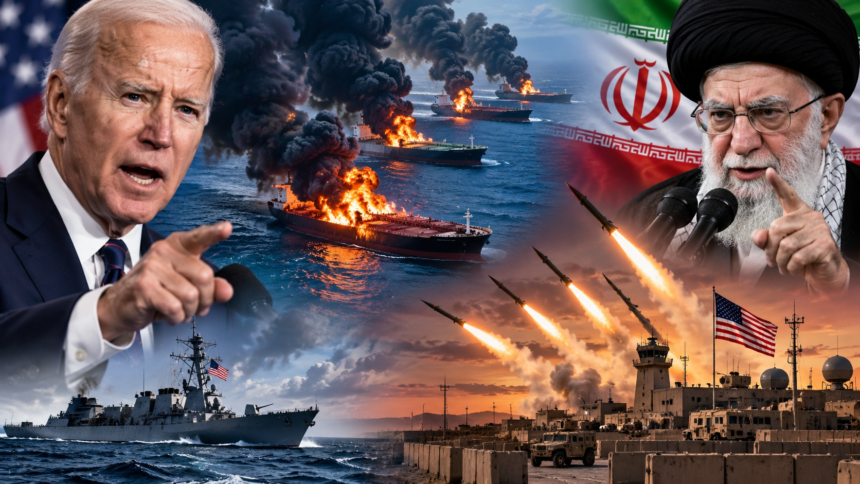
Washington [USA], September 9: Tensions between the United States and Iran have escalated sharply after the US military said it destroyed five Iranian oil tankers, prompting Iran’s Revolutionary Guard to launch ballistic missiles at a US military facility in Jordan.
The latest exchange marks another major escalation in the more than six-month-old conflict, with military operations now affecting oil tankers, naval vessels, military bases and shipping routes around the Strait of Hormuz.
Why Did the US Attack the Iranian Tankers?
According to the US Central Command, American forces destroyed five Iranian oil carriers after Iran’s Islamic Revolutionary Guard Corps (IRGC) targeted a US Navy warship with ballistic missiles twice over two days.
The US said the warship successfully avoided the attacks and that no American personnel were injured.
The five tankers identified by US Central Command were Kaviz, Charminar, Horizon 1, Riesco and Derya. Four were struck in the Gulf of Oman, while the Derya was targeted near Iran’s Kharg Island.
US forces said the crews were ordered to leave the vessels before the strikes were carried out.
US Secretary of State Marco Rubio also warned that Washington would continue responding if Iranian forces attempted to attack US naval vessels.
Iran Hits US Base in Jordan
Iran responded to the tanker strikes with a ballistic missile attack targeting a US military facility near Al Azraq in Jordan, according to Iran’s Revolutionary Guard and state media.
Jordan’s military said its air-defence systems intercepted 18 of 20 Iranian ballistic missiles launched towards the country. The remaining two missiles reportedly landed in unpopulated areas.
Jordan said there were no casualties from the attack. US officials also said American personnel at the base were accounted for and that the Iranian attack did not achieve its intended effect.
Iran, however, claimed that the strikes caused significant damage to facilities at the base, including areas used by US fighter aircraft. Those claims have not been independently verified.
Strait of Hormuz Becomes Another Flashpoint
The confrontation has also spread to commercial shipping in the Strait of Hormuz, one of the world’s most important energy routes.
Iran’s IRGC said its naval forces attacked 10 vessels, including two US-linked vessels and eight oil tankers, that were attempting to pass through what Tehran described as a prohibited and unsafe area.
Iranian forces have also warned tanker crews at ports in Kuwait and Bahrain to evacuate their vessels, raising concerns about further attacks on commercial shipping.
The developments have increased concerns over the security of one of the world’s most important oil transportation routes.
Oil Prices Move Towards $100
The latest military escalation has immediately raised concerns in global energy markets.
Oil prices moved sharply higher, with Brent crude approaching $100 a barrel amid fears that continued attacks could further disrupt tanker traffic through the Strait of Hormuz.
Any prolonged disruption in the region could have consequences well beyond the Middle East, potentially affecting fuel prices, shipping costs and inflation in countries dependent on imported energy.
US-Iran Conflict Enters a More Dangerous Phase
The latest confrontation comes after a period of relative calm between the two sides.
The conflict has already involved attacks on military installations, oil infrastructure and shipping routes. The destruction of five Iranian tankers and Iran’s subsequent missile attack on a US base in Jordan now raises the possibility of further retaliation.
Jordan is a close US ally and hosts American military personnel, making US facilities on its territory an important part of Washington’s regional military presence.
Iran’s leadership had previously warned that attacks on Iranian oil tankers would trigger strikes against US military installations in the region.
More Attacks Reported Across the Region
The escalation has not been limited to US and Iranian forces.
Iran-aligned Houthi forces in Yemen have also launched attacks against targets in Saudi Arabia, adding another layer to the growing regional crisis. Reports say the attacks caused casualties and damage to energy-related infrastructure.
The expanding conflict is therefore increasingly involving multiple countries and strategic shipping routes, raising concerns that the confrontation could widen further.
What Happens Next?
The immediate concern is whether the US and Iran will continue the cycle of attack and retaliation.
Washington has indicated that it intends to maintain pressure on Iranian oil exports and protect shipping routes, while Tehran has threatened further attacks against US military assets and vessels connected to the US.
With the Strait of Hormuz already under severe pressure and oil prices approaching the $100 mark, further military action could have significant consequences for both regional security and the global economy.
For now, the destruction of the five tankers followed by Iran’s missile attack on the Jordan base represents one of the most serious escalations in the conflict in recent weeks.