


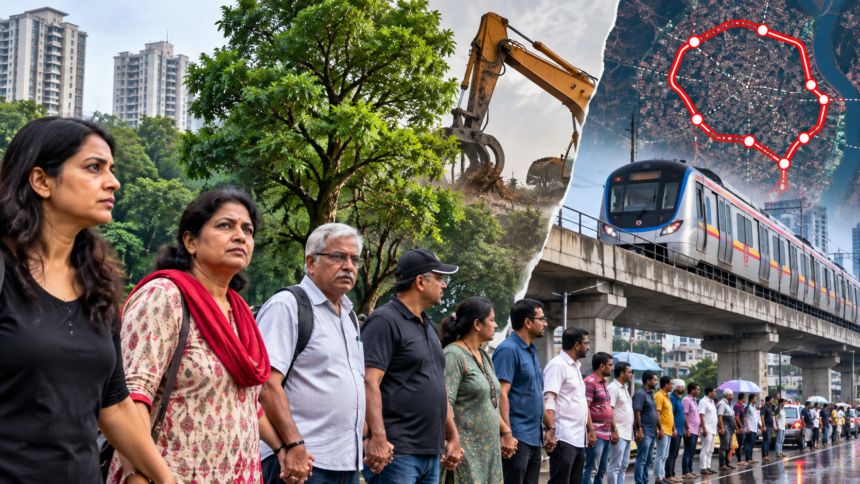
Thane [India], September 9: Thane Metro – Opposition to the proposed Thane Integral Ring Metro project is gaining momentum, with hundreds of residents forming a human chain on Pokhran Road No. 2 and questioning whether the city actually needs another major metro corridor.
- Residents Ask: Is Another Metro Corridor Really Needed?
- Protesters Want Better TMT Bus Services
- Nearly 3,900 Trees Become a Major Concern
- Displacement and Rehabilitation Questions
- Route Alignment Also Under Scrutiny
- Underground Section Near Thane Station
- Government Yet to Face Down Growing Opposition
- DPR Expected by January 2027
The protest, organised by the citizens’ group Thane Against Integral Ring Metro, was held between Swami Junction and Prashant Corner on Sunday. Despite heavy rain, residents, business owners and environmental activists joined the demonstration, raising concerns about the project’s cost, environmental impact, displacement and the city’s existing public transport needs.
Residents Ask: Is Another Metro Corridor Really Needed?
One of the central arguments raised by protesters is that Thane already has Metro Lines 4 and 5 under development.
Residents said the government should first assess passenger numbers and utilisation of these existing and upcoming corridors before committing to another large-scale rail project.
Activist Advocate Radhika Rane said ridership data from Metro Lines 4 and 5 should be evaluated first. According to protesters, if these corridors can adequately address the city’s transport demand, the necessity of another ring metro should be reconsidered.
The protesters have stressed that their opposition is not against public transport or infrastructure development in general. Instead, they want the government to establish the project’s necessity and assess its long-term impact before proceeding.
Protesters Want Better TMT Bus Services
Another major demand raised during the demonstration was the strengthening of Thane Municipal Transport (TMT).
Residents argued that improving the city’s existing bus network could provide faster and more immediate relief to commuters.
Their demands include:
- Increasing the TMT bus fleet
- Raising bus service frequency
- Expanding connectivity to areas with limited public transport
- Improving road infrastructure
- Making public transport more accessible across the city
Protesters believe these measures should be prioritised before spending thousands of crores on another rail corridor.
Nearly 3,900 Trees Become a Major Concern
Environmental impact has emerged as another major point of opposition.
Activists have raised concerns over plans that could affect approximately 3,900 trees as part of the project.
Environment activist Rohit Joshi alleged that Thane had not had a properly constituted Tree Authority Committee for nearly six months following the municipal elections. He questioned the process through which tree-cutting permissions were being considered and said citizens’ objections had not been adequately heard.
Joshi has warned that if tree cutting begins without a proper public hearing, he would consider challenging the permissions in court. These are allegations raised by the activist and remain subject to the applicable legal and administrative process.
Radhika Rane also raised concerns about tree transplantation, arguing that many transplanted trees do not survive.
Displacement and Rehabilitation Questions
The controversy is not limited to environmental concerns.
Residents and public representatives have also questioned how many families could be affected by the proposed alignment and what rehabilitation arrangements would be provided.
Recent discussions around the project have indicated that approximately 1,400 to 1,500 families in areas including Lokmanya Nagar, Manoramanagar and Sevalal Nagar could potentially be affected.
However, concerns have been raised over incomplete displacement surveys and the lack of clarity regarding rehabilitation plans. NCP (SP) MLA Jitendra Awhad has claimed that around 30 per cent of slum surveys remain incomplete.
The issue has therefore become a key demand from residents, who want clear information about land acquisition, displacement and rehabilitation before the project moves ahead.
Route Alignment Also Under Scrutiny
The proposed alignment has also triggered questions from political representatives.
State Transport Minister Pratap Sarnaik has reportedly expressed displeasure over being left out of discussions concerning route-alignment decisions.
Meanwhile, Thane Municipal Commissioner Saurabh Rao has said around 70 per cent of the required route alignment is already available, with the remaining land acquisition process expected to be accelerated.
Rao has also said that rehabilitation of affected residents would be given priority and that suggestions from elected representatives and other stakeholders would be considered while preparing the Detailed Project Report.
Underground Section Near Thane Station
The project is also expected to include an underground section near Thane railway station.
According to MahaMetro, the underground tracks in this section would be constructed at a depth of around 20 metres. The agency has also indicated that buildings located within five metres of the underground alignment would require safety clearances for construction.
This has added another layer to the concerns surrounding the project’s impact on existing buildings and urban infrastructure.
Government Yet to Face Down Growing Opposition
The latest human-chain protest comes just a week after the citizens’ group launched a signature campaign against the project.
The progression from a signature campaign to a street-level demonstration indicates that opposition is becoming more organised. Protesters have said they will intensify the movement if their concerns are not addressed.
Their broader argument is that Thane needs better public transport, but the city also needs better roads, functioning buses, environmental protection and clarity on rehabilitation.
DPR Expected by January 2027
The civic administration has indicated that public representatives and other stakeholders will be able to submit written suggestions for consideration in the project’s Detailed Project Report (DPR).
The DPR is expected to be prepared by January 2027, giving authorities time to consider concerns surrounding alignment, land acquisition, rehabilitation and environmental impact.
For now, the proposed ₹12,100-crore Thane Integral Ring Metro remains at the centre of a growing civic debate.
Supporters of the project see it as a major solution for improving connectivity within Thane, while opponents argue that the government should first establish the corridor’s necessity and address the city’s immediate transport and infrastructure problems.
The human chain on Pokhran Road has made one thing clear: the debate over Thane’s next major metro project is no longer confined to government offices and planning meetings—it has moved onto the streets.