

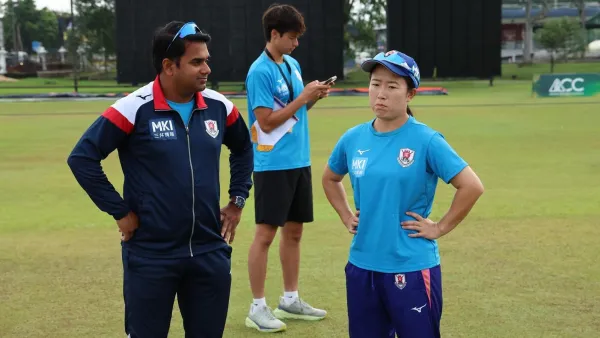
Mumbai [India], September 18: A Mumbai club cricketer’s journey from early-morning practice sessions in the city’s maidans to the international stage has reached a remarkable point. Vinay Iyer, 41, is the head coach of Japan’s women’s cricket team, and on Friday he will be in the dugout as Japan take on India in the women’s cricket quarter-final at the Aichi-Nagoya Asian Games 2026.
For Iyer, the fixture carries a personal significance. His cricketing journey began in Mumbai and Thane, where he played club cricket, competed in the Kanga League and trained at local grounds. Years later, he finds himself preparing a Japanese national side to face the country where his own cricketing ambitions first took shape.
Iyer grew up playing at Thane’s Central Maidan and later moved into Mumbai’s competitive club cricket circuit. He played for Sundar Cricket Club in the Kanga League and also captained his college team to an inter-collegiate championship. Among the coaches who influenced him during his early years was former India cricketer Ashok Mankad, who encouraged him to pursue opportunities in higher-level cricket.
His routine during those years reflected the demanding life of a Mumbai club cricketer. Iyer would leave home early in the morning, travel from Thane to the city and reach the Police Gymkhana at Charni Road for practice before continuing with college and work. Later, he would juggle cricket practice in Charni Road with an office in Andheri and his home in Thane.
A potential path into state cricket did not work out, and eventually Iyer joined diamond company Rosy Blue, which also had a cricket team playing in the Times Shield. The decision to take up employment changed the direction of his career but did not end his involvement with the sport. Instead, his job eventually took him to Japan.
Iyer first travelled to Japan in 2009 for work and later moved there permanently in 2013. Once he discovered that cricket was being played in the country, he began looking for opportunities to continue his playing career. He joined Tokyo-based club cricket and made a name for himself in Japan’s domestic competitions. In 2015, he topped the league’s run charts and was named Player of the Year.
When changes to Japan’s eligibility rules prevented foreign players from continuing in the national setup, Iyer did not walk away from the game. He founded the Kawasaki Knight Riders, initially building youth teams before developing the club further. That experience gradually pushed him towards coaching and player development.
His transition from player to coach gathered pace after the Covid period. Iyer became involved with Japan’s age-group programmes and worked with the men’s Under-16 and Under-19 setups. He also joined the Japan National Academy and gained experience with the country’s women’s team. These roles eventually led to his appointment as head coach of Japan’s women’s national team in 2025.
The Japan Cricket Association officially lists Iyer as the head coach of its women’s team for the 2026 Asian Games. The association’s squad announcement also confirms that Japan were drawn to face India in the quarter-final at Korogi Sports Park in Nisshin, Aichi Prefecture, on September 18.
The matchup has added an unusual emotional dimension for Iyer. He once dreamed of playing at Mumbai’s Wankhede Stadium and remembers facing young Indian cricketers who would later become prominent names. In a recent interview, he recalled playing in a West Zone age-group match involving Rohit Sharma and Cheteshwar Pujara, an experience he still remembers from his Mumbai cricket days.
Now, instead of facing India’s players himself, Iyer is responsible for helping Japan prepare for them. He has spoken about the challenge of telling his bowlers how to approach Indian batters and admitted that he is trying not to show his own nervousness to the players ahead of the game.
The contrast between the cricketing environments in India and Japan is also significant. While Mumbai has a deeply established club-cricket structure, Japan’s women’s programme is still developing. Iyer has described how Japanese players often have to balance cricket with other commitments and how training opportunities are more limited. For the Asian Games, Japan assembled a three-week camp to prepare for the tournament.
Iyer has also continued working his regular job in Tokyo while developing cricket in Japan. He has used modern training methods to monitor players remotely, with athletes recording practice sessions and sharing them for feedback. His focus has been on building a sustainable cricket pathway rather than simply preparing one team for a single tournament.
The Japan Cricket Association’s 2026 women’s squad includes players from clubs and institutions in Japan as well as overseas cricket programmes. The association has also been expanding its women’s national academy structure, with the aim of developing players for future national teams.
For Iyer, the Asian Games appearance represents another chapter in a cricket journey that has travelled far beyond the Mumbai grounds where it began. From catching an early bus from Thane for morning practice to coaching Japan against India at a major multi-sport event, his career has taken an unexpected route while remaining connected to the game throughout.
The Japan-India quarter-final will therefore be more than just another fixture for the Mumbai-born cricket coach. It will bring him back into the spotlight against the cricketing system that shaped his early years, this time from the opposite side of the boundary.